Blood pressure chart by age and gender
Most charts online show a different "normal" for every age. Under the current guideline, the healthy range for adults is the same at 25 as at 75. Here's the chart doctors use, and how blood pressure really changes with age and sex.
In short: for every adult, at 30 or at 80, normal is under 120/80. 120–129 over less than 80 is elevated, and 130/80 or higher is high blood pressure, for clinic readings and home averages alike. Want to check one reading? Use the blood pressure checker, which also shows every common reading on one chart.
The blood pressure chart for adults
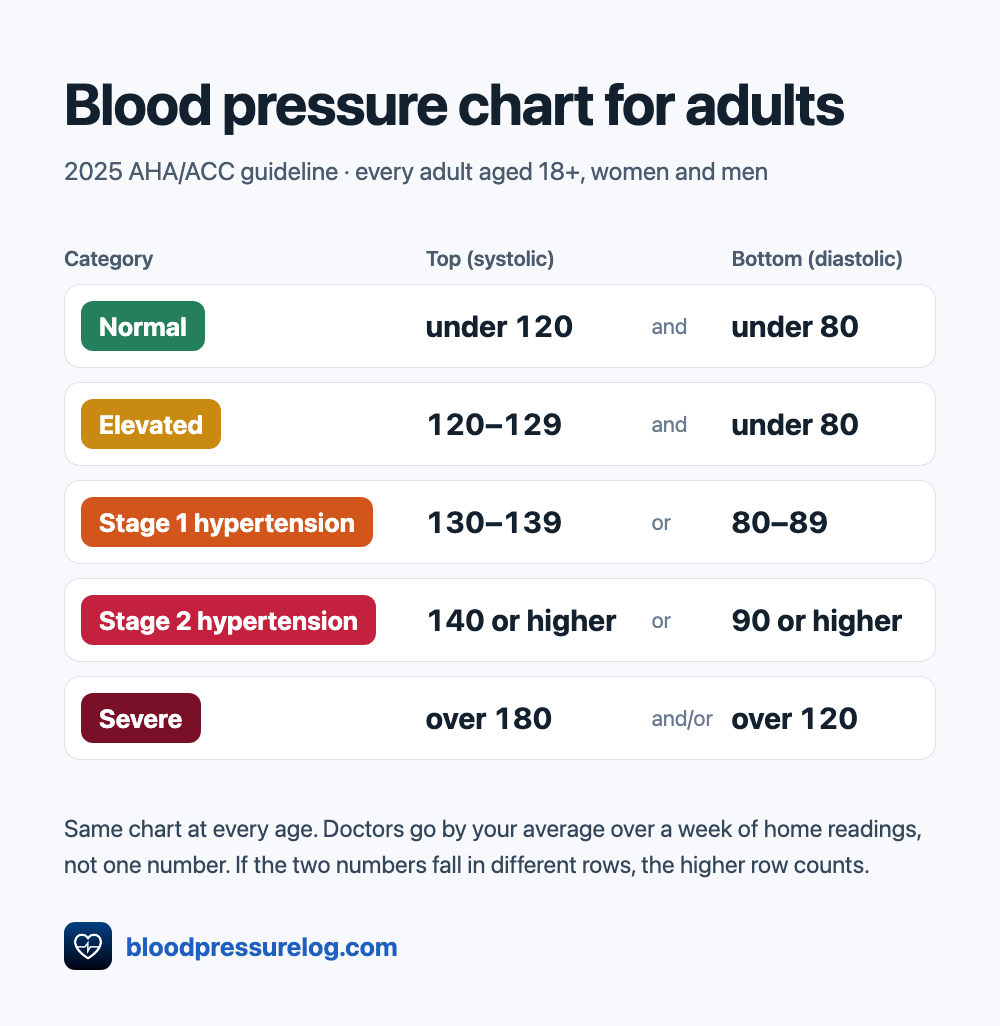
This chart, from the American Heart Association and American College of Cardiology, applies to everyone aged 18 and over:
| Category | Systolic (top) | Diastolic (bottom) | |
|---|---|---|---|
| Normal | Under 120 | and | Under 80 |
| Elevated | 120–129 | and | Under 80 |
| Stage 1 hypertension | 130–139 | or | 80–89 |
| Stage 2 hypertension | 140 or higher | or | 90 or higher |
| Severe | Higher than 180 | and/or | Higher than 120 |
If your two numbers fall in different rows, go by the higher one. To check a specific reading, use our blood pressure reading checker.
Normal blood pressure by age
Here's the part many charts get wrong. There's a difference between what's common at an age and what's healthy. Blood pressure tends to rise as arteries stiffen, so the average 70-year-old has a higher reading than the average 30-year-old. But higher blood pressure still raises the risk of stroke, heart attack and kidney disease at any age. That's why the guideline uses one healthy range for all adults.
| Age | Healthy (normal) | High blood pressure starts at |
|---|---|---|
| 18–39 | Under 120/80 | 130/80 |
| 40–59 | Under 120/80 | 130/80 |
| 60–79 | Under 120/80 | 130/80 |
| 80 and over | Under 120/80 | 130/80; treatment goals are set individually |
So what does change with age?
- Systolic (top number) tends to rise steadily through adulthood as large arteries become less elastic.
- Diastolic (bottom number) tends to rise until middle age and then level off or fall. That's why many older adults have a high top number with a normal or low bottom number, called isolated systolic hypertension.
- High blood pressure becomes more common with every decade. Most adults over 65 have it.
Average blood pressure by age and gender
If you want to compare yourself with other people your age, these are the averages measured in a large US government survey (NHANES, 2001–2008), counting everyone, including people taking blood pressure medication:
| Age | Women, average | Men, average |
|---|---|---|
| 18–39 | 110/68 | 119/70 |
| 40–59 | 122/74 | 124/77 |
| 60 and over | 139/68 | 133/69 |
Two things stand out. The top number climbs with every age group, especially in women after 60, while the bottom number peaks in middle age and then drops. And the averages after 40 already sit above the healthy range: an average isn't a target. For what's normal at 60, 70 and 80, and how treatment goals change, see normal blood pressure for older adults.
Women and men
The chart and the healthy range are the same for women and men. The patterns over a lifetime differ:
- Before about 50, men on average have higher blood pressure than women.
- After menopause, women's blood pressure tends to rise faster, and by older age high blood pressure is at least as common in women as in men.
- Pregnancy, some contraceptive pills and conditions like polycystic ovary syndrome can affect blood pressure, so women have specific moments when checking matters more.
A "normal blood pressure for a woman of 50" is therefore the same as for anyone: under 120/80.
Older adults
For people in their 70s and 80s, the healthy range is the same, but decisions about treatment are more individual. Doctors weigh things like frailty, falls, other medications and dizziness on standing. If you're logging for an older parent, note any light-headedness when they get up; it's useful information for their doctor. Our guide to normal blood pressure for older adults covers this in more detail.
Readings in older adults also vary more from day to day, which makes a week of home readings more informative than any single clinic reading.
Children, teens and pregnancy
Children under 13 don't use the adult chart. Their blood pressure is compared with other children of the same age, sex and height using percentile tables, so ask your child's doctor how to read their numbers.
Teens 13 and older use thresholds close to the adult ones.
During pregnancy, blood pressure is monitored closely because conditions like preeclampsia need quick attention. Your midwife or obstetrician will tell you which numbers to act on. If a reading is high and you have a severe headache, vision changes or pain under the ribs, seek care immediately.
Common questions
Is 120/80 a normal blood pressure?
Almost. Normal is below 120/80, so 120/80 itself falls in stage 1 under the 2025 guideline because the bottom number is 80. A home average right at 120/80 isn't a cause for alarm, but it's worth keeping an eye on.
What is normal blood pressure for a 60- or 70-year-old?
The same as for any adult: under 120/80. Average readings are higher at 60 and 70, but higher readings still raise the risk of stroke and heart disease. What changes with age is the treatment goal, which a doctor sets individually. See normal blood pressure for older adults.
What is normal blood pressure for a woman?
The same chart applies to women and men: under 120/80 is normal. Women's blood pressure tends to rise faster after menopause, so that's a good time to check more often.
What blood pressure is dangerous?
A reading above 180/120 is severe. Rest a minute and measure again. If it's still that high and you have chest pain, shortness of breath, numbness or weakness, vision changes or trouble speaking, call 911 or your local emergency number.
How do I get an accurate number?
One reading says little. Measure twice in the morning and twice in the evening for a week and use the average, which is what the printable blood pressure log is made for. Our guide to taking blood pressure at home covers the details.
Sources
- American Heart Association: Understanding blood pressure readings
- American Heart Association: Top things to know: 2025 high blood pressure guideline
- Centers for Disease Control and Prevention: About high blood pressure
- National Center for Health Statistics: Mean systolic and diastolic blood pressure in adults, 2001–2008 (tables 3, 4, 6 and 7)